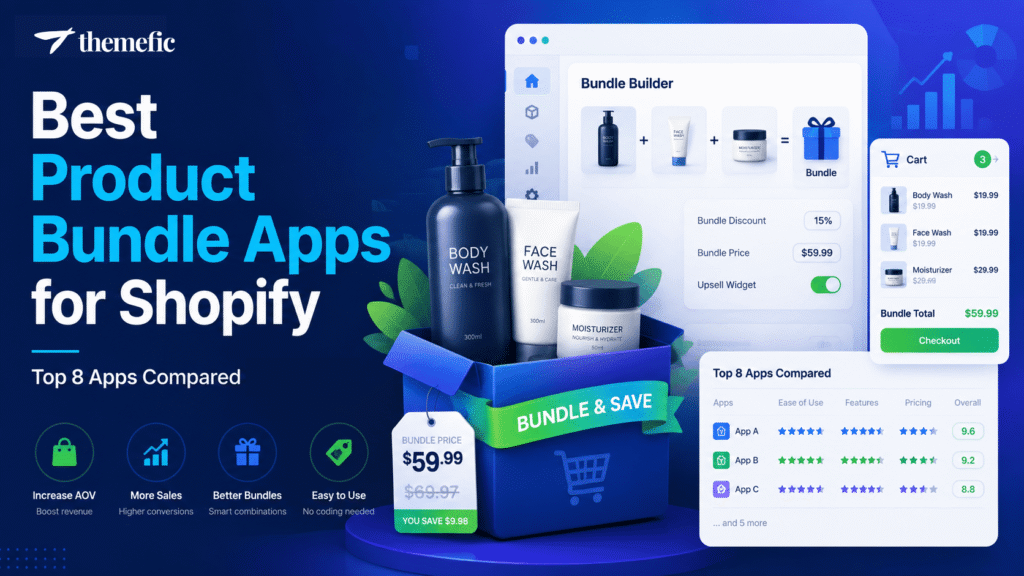
The best product bundle apps for Shopify in 2026 are Simple Bundles & Kits, Bundler, Fast Bundle, Shopify Bundles, Amplify (formerly PickyStory), Kaching Bundles App & Upsells, BundleJET, and Easy Bundles: Bundle Builder. Each app supports different bundle types (fixed bundles, mix and match, volume discounts, BOGO) and fits different store sizes, from solo brands to high-SKU 3PL operations.
Product bundling is one of the simplest ways to raise average order value (AOV) without adding new traffic. Instead of manually creating variants or juggling inventory workarounds, a bundle app handles the pricing, inventory sync, and checkout logic for you. Below is a breakdown of the top Shopify bundle apps on the market right now, what each one does well, where it falls short, and a direct App Store link so you can check current reviews and pricing before installing.
Why Product Bundling Works for Shopify Stores
Before jumping into the app comparisons, it’s worth understanding why bundling has become one of the highest-ROI tactics for Shopify merchants in 2026.
A bundle changes the decision a shopper is making. Instead of asking “should I buy this one product,” they’re asking “should I take the better deal in front of me.” That reframing is what drives the AOV lift. Bundling also helps with a few operational problems at the same time:
- It moves slow-selling inventory. Pairing a slower SKU with a bestseller gets it in front of buyers who might not have found it on their own.
- It simplifies the buying decision. Curated kits and starter packs reduce the research a new customer has to do, which matters a lot for gift-giving occasions and first-time buyers.
- It increases perceived value without deep discounting. A “3 for the price of 2.5” bundle often converts better than a flat 10% off sitewide, because the customer feels like they’re getting more, not just paying less.
- It works at every stage of the funnel. Bundles can show up on the product page, inside the cart drawer, or as a post-purchase offer after checkout, so you’re not limited to one touchpoint.
The catch is that Shopify’s native tools only go so far. Manually creating a bundle as its own product means managing separate SKUs, syncing inventory by hand, and losing the ability to run mix-and-match or quantity break offers. That’s the gap the apps below are built to close.
Quick Answer: Top Shopify Bundle Apps at a Glance
| App | Best For | Free Plan |
|---|---|---|
| Simple Bundles & Kits | High-SKU stores, 3PL/inventory sync | Yes |
| Bundler ‑ Product Bundles App | Budget-friendly, straightforward pricing | Yes |
| FBP | Fast Bundle & Upsell App | AI-powered FBT and advanced merchandising | Trial only |
| Shopify Bundles | Simple fixed bundles, no extra app cost | Free (native) |
| Amplify | Bundles & Upsell | Bundles plus post-purchase upsell in one app | Free dev store |
| Kaching Bundles App & Upsells | Quantity breaks and BOGO deals | Yes |
| BundleJET | Build-a-box and wholesale-style bundles | Yes |
| Easy Bundles: Bundle Builder | Build-your-own-bundle (BYOB) experiences | Trial only |
Types of Bundles in Shopify
Not all bundles work the same way. Before picking an app, it helps to know which bundle types actually exist, since some apps only support one or two of these while others cover the full list.
- Fixed Bundles: A set group of products sold together at one price, such as a “starter kit” containing three specific items. The customer can’t swap anything out. This is the simplest bundle type and the one Shopify’s native Bundles app supports.
- Mix and Match: The customer picks any combination of items from a defined collection to unlock a discount, for example “choose any 4 items from this collection for $60.” This works well for stores with many similar-priced SKUs, like snacks, skincare, or apparel basics.
- Build Your Own Bundle (BYOB) / Build-a-Box: Similar to mix and match, but usually with more flexibility across a wider product range and often a visual “build your box” interface. Customers add items until they hit a minimum, maximum, or fixed quantity you’ve set.
- Volume Discounts (Quantity Breaks): The price per unit drops as the customer buys more of the same product, such as “buy 2, save 10%, buy 4, save 20%.” This is one of the most common bundle types because it’s simple to set up and easy for shoppers to understand.
- Buy X Get Y (BOGO): The customer gets a free or discounted item after buying a qualifying product or quantity, for example “buy 2, get 1 free” or “buy this, get a free sample.” BOGO offers are effective for clearing inventory and introducing customers to a new product at low risk.
- Frequently Bought Together (FBT): The app shows complementary products that pair well with what’s already in the cart or on the product page, often powered by AI based on past order history. This is a lighter-touch bundle since the customer can add items with one click rather than committing to a pre-set kit.
- Cross-Sell and Upsell Bundles: Shown in the cart drawer or at checkout, these bundles nudge the customer toward a slightly larger or more complete purchase, such as adding a matching accessory before completing checkout. Because the shopper already has buying intent at this stage, cart-based bundles tend to convert well.
- Subscription Bundles: A bundle tied to a recurring order, where the discount applies to every delivery or only the first one, depending on how you configure it. This is common for consumables, supplements, and coffee or skincare subscriptions where customers reorder a set combination regularly.
- Wholesale or B2B Bundles: Bundles priced differently for wholesale accounts than retail customers, often gated behind a login or customer tag. Useful for stores that sell the same catalog to both individual shoppers and bulk buyers.
Most merchants don’t need every bundle type at once. The apps reviewed below differ mainly in how many of these types they support and how much control you have over configuring each one.
Top 8 Best Product Bundle Apps for Shopify in 2026 – The Review
1. Simple Bundles & Kits
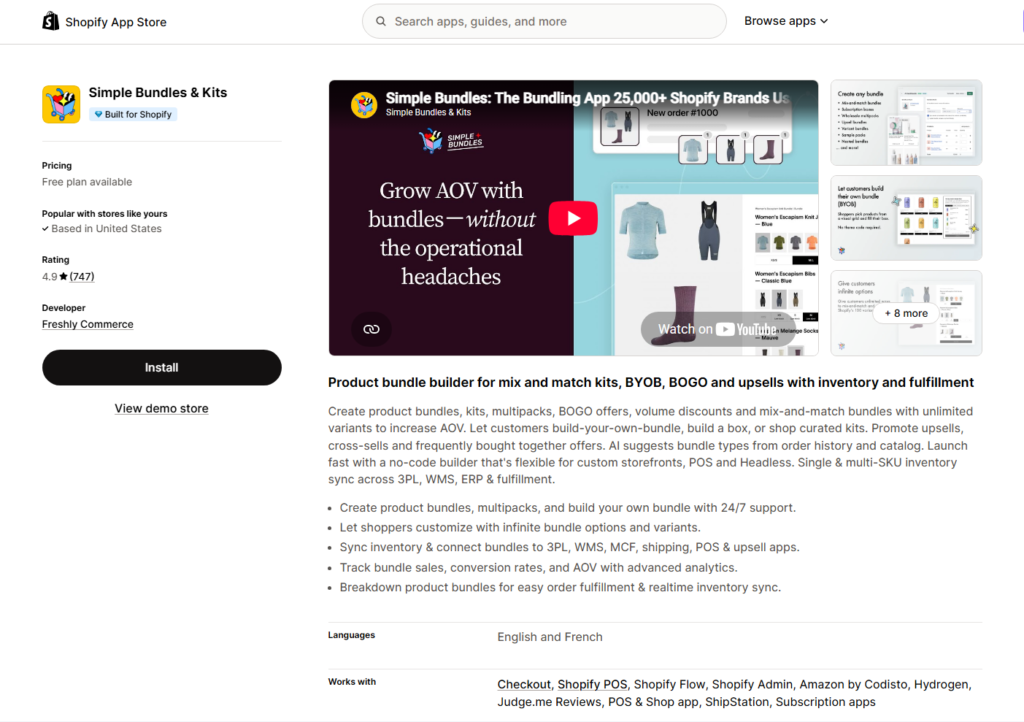
Best for: Stores with complex, high-SKU catalogs that need real-time inventory sync across fulfillment systems.
Simple Bundles & Kits is built for merchants who need more than a basic bundle widget. It supports mix-and-match, build-your-own-bundle (BYOB), multipacks, and quantity discounts, and it syncs single and multi-SKU inventory across 3PL, WMS, ERP, and POS. It also includes an AI feature that suggests bundle types based on your order history and catalog.
The bulk import function is one of its most useful features for larger catalogs. Merchants managing thousands of SKUs can create bundles in bulk rather than configuring each one individually, which saves significant setup time when launching a new bundled collection. It also breaks bundles down at checkout so fulfillment teams can see every individual item that needs to be picked and packed, which reduces shipping errors on multi-item orders.
Ideal store size: Mid-market to enterprise stores with complex SKU structures, multiple warehouses, or existing 3PL relationships.
Pros:
- Strong inventory and fulfillment sync.
- Works with headless and POS setups.
- Responsive support.
- Bulk import for large catalogs.
Cons:
- More configuration is required to unlock the advanced features compared to simpler bundle apps, and the depth of options can feel like overkill for a small single-warehouse store.
App Store link: apps.shopify.com/simple-bundles
2. Bundler ‑ Product Bundles App
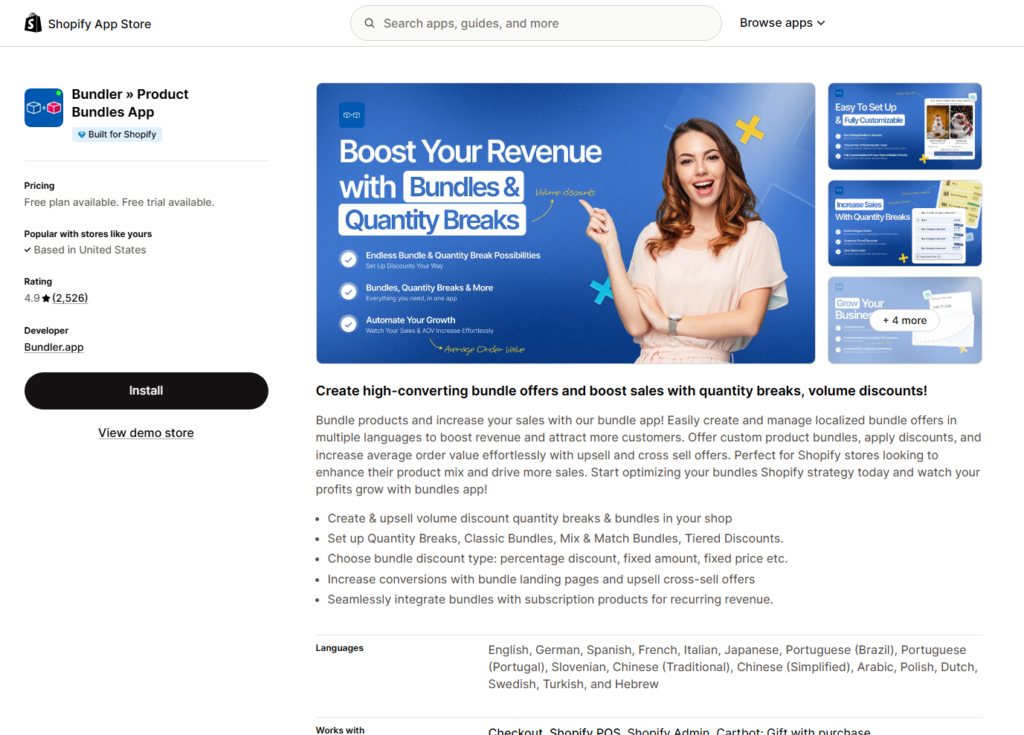
Best for: Merchants who want straightforward, flat pricing without revenue-based fees.
Bundler supports classic bundles, mix-and-match, volume discounts, wholesale discounts, and BOGO deals, plus bundle landing pages and shortcodes for promotions. It integrates with page builders like PageFly and GemPages and works alongside subscription apps such as Seal Subscriptions, including the ability to apply a bundle discount only on the initial order or across all recurring shipments.
A number of merchants who switched to Bundler after another app was removed from the App Store cite the flat, predictable pricing as the main reason they stayed. There’s no revenue-share model to track, and the discount logic can be configured to either combine with or block additional discount codes at checkout, which gives you more control over margin during promotional periods.
Ideal store size: Small to mid-sized stores that want predictable monthly costs and don’t need enterprise-level fulfillment integrations.
Pros:
- Simple flat pricing, no unexpected charges based on order volume,
- Easy setup for first-time bundle app users.
- Works well with page builders.
Cons:
- Fewer AI-driven merchandising features than newer competitors.
- Bulk bundle creation for large seasonal launches currently has to be done one bundle at a time.
App Store link: apps.shopify.com/bundler-product-bundles
3. FBP – Fast Bundle & Upsell App
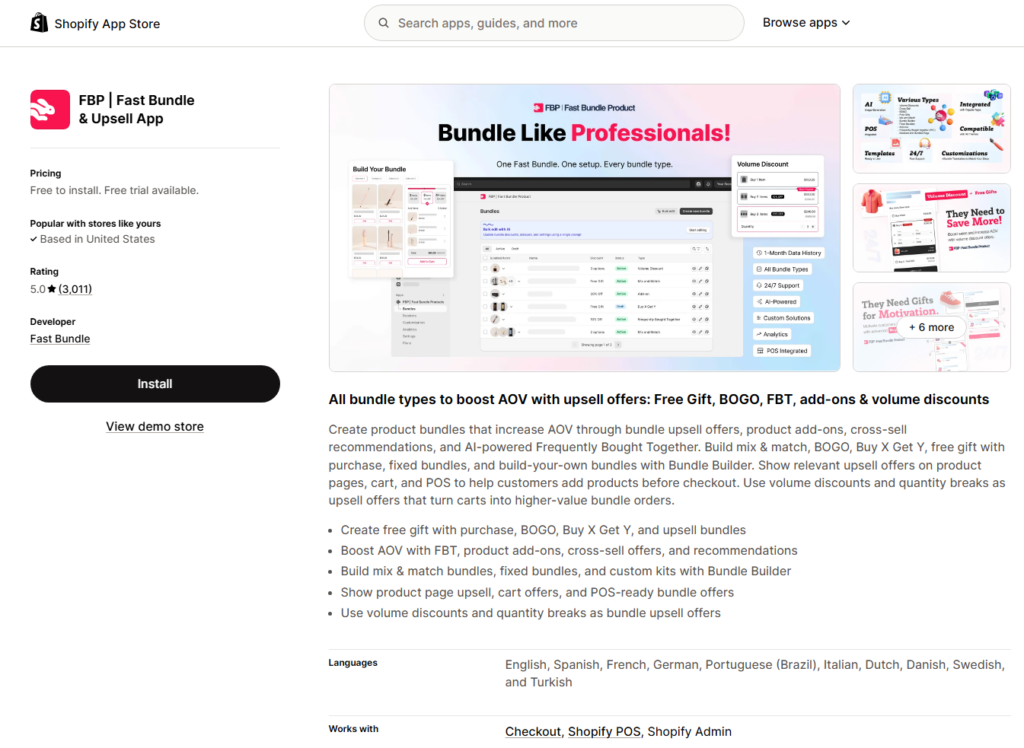
Best for: Stores that want AI-assisted bundle recommendations and a wide range of bundle types in one app.
Fast Bundle covers fixed bundles, mix and match, volume discounts, BOGO, and product add-ons, and includes AI-powered Frequently Bought Together (FBT) suggestions and AI bundle image generation. It also integrates with Shopify POS for in-store bundle sales, so bundles created online can be sold in a physical retail location without separate configuration.
What sets Fast Bundle apart from simpler apps is the depth of its AI tooling. The AI bulk editing feature lets you update pricing or product combinations across many bundles at once instead of editing each one individually, and the AI-generated bundle imagery saves time for stores that don’t have design resources to create custom bundle graphics for every offer. Pricing generally starts around $19 per month for stores generating up to a set amount of revenue through the app’s offers, then scales up from there.
Ideal store size: Growing stores that want AI-assisted merchandising and are comfortable with usage-based pricing as they scale.
Pros:
- Broad feature set.
- AI merchandising tools.
- Active development.
- Strong POS integration.
Cons:
- The app was briefly removed from the Shopify App Store earlier in 2026 before being reinstated, which is worth knowing if store continuity matters to you.
- Pricing scales with revenue generated through the app rather than staying flat.
App Store link: apps.shopify.com/fast-bundle-product-bundles
4. Shopify Bundles (Native App)
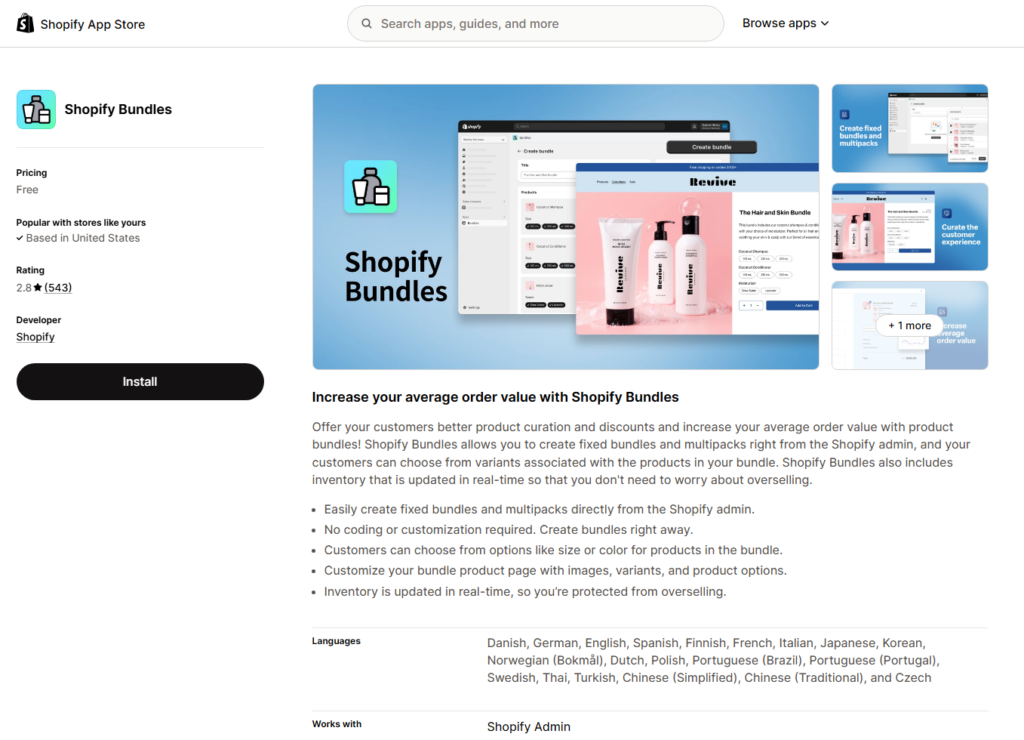
Best for: Stores that just need simple fixed bundles or multipacks without paying for a third-party app.
Shopify Bundles is built and maintained by Shopify itself. You can create fixed bundles and multipacks directly from the admin, and customers can choose variants tied to the bundled products. Inventory updates in real time, so you don’t need to worry about overselling a bundle when one of its components sells out.
Because it’s a native Shopify feature rather than a third-party app, it also supports a long list of storefront languages out of the box, which is a nice bonus for stores selling internationally. The trade-off is flexibility. The app currently caps bundles at three options each, and only supports up to roughly 100 potential variant combinations per bundle, so a bundle of two apparel items with color and size options each can hit that ceiling quickly.
Ideal store size: New or small stores that want to test bundling with zero monthly cost before investing in a paid app.
Pros:
- Completely free
- No third-party app to manage
- Tightly integrated with Shopify admin
- Wide language support.
Cons:
- Limited to 3 options per bundle and roughly 100 potential variant combinations, which makes it unworkable for bundles with several variant-heavy products.
- No mix-and-match, BOGO, or volume discount support.
App Store link: apps.shopify.com/shopify-bundles
5. Amplify | Bundles & Upsell (formerly PickyStory)
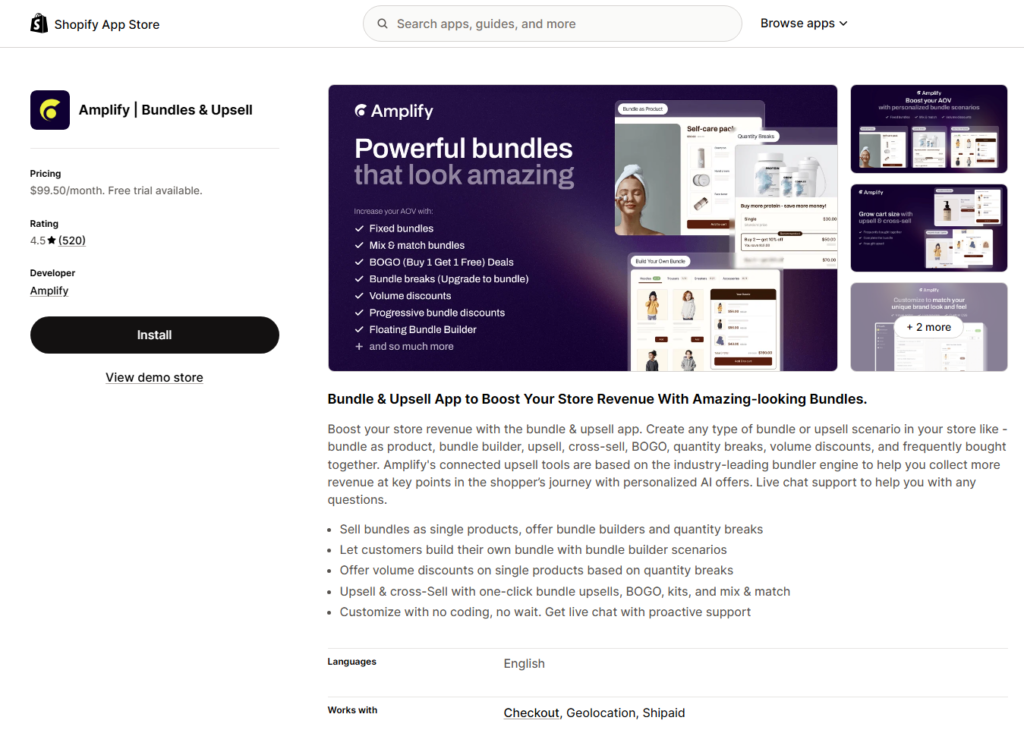
Best for: Stores that want bundles, a cart drawer, and post-purchase upsells bundled into a single platform.
Amplify (the app was previously known as PickyStory) offers bundle builder, BOGO, quantity breaks, mix-and-match, “shop the look” lookbooks, and a slide cart with tiered rewards. It’s a broader conversion suite rather than a single-purpose bundle app, which is useful if you’d rather consolidate several conversion tools under one vendor instead of running separate apps for bundles, cart upsells, and subscriptions.
The “shop the look” and lookbook features are fairly unique among bundle apps and are worth a look if you sell apparel, home goods, or anything else that benefits from styled product groupings rather than plain discount bundles. Plans start at a low entry price for basic bundling, but several merchant reviews describe unexpectedly high monthly charges once revenue attribution and commission-based billing are factored in, so it’s worth reading the current pricing page in detail and asking support to clarify how charges are calculated before switching over a large catalog.
Ideal store size: Stores that want bundling, lookbooks, and post-purchase upsells consolidated into one platform and are comfortable evaluating a usage-based pricing model.
Pros:
- Combines bundling with upsell and cart tools.
- Reducing the need for multiple apps.
- Unique lookbook and shop-the-look features.
Cons:
- Some merchant reviews mention billing based on a percentage of attributed revenue and inconsistent support experiences during outages.
- Compare the pricing terms closely against a flat-fee app like Bundler before committing.
App Store link: apps.shopify.com/product-kits-bundles-pickystory
6. Kaching Bundles App & Upsells
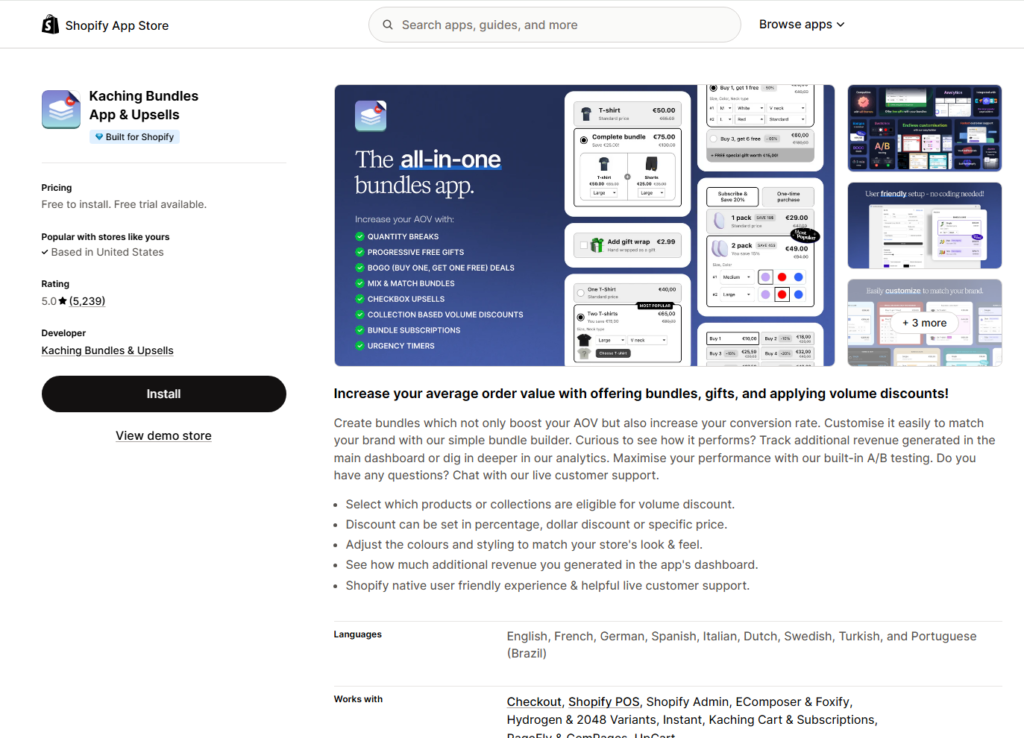
Best for: Stores that primarily want quantity breaks and “buy more, save more” style offers.
Kaching focuses on volume discount bundles and BOGO-style deals, built using Shopify Functions for faster performance and no theme code edits. It includes A/B testing to help optimize bundle offers and integrates with page builders like GemPages. It also supports tying specific bundle sizes to matching subscription delivery frequencies, which is useful for stores selling consumables or supplements where customers might want a 3-pack shipped every three months.
Kaching automatically displays bundle offers on product pages without extra theme setup, and it can combine one-time purchases and subscription products in a single checkout flow. Merchant reviews frequently highlight fast, hands-on support for troubleshooting migration issues when switching over from another bundle app, including help correcting inventory or fulfillment-location settings that can otherwise cause checkout errors.
Ideal store size: Any store primarily focused on “buy more, save more” and BOGO offers rather than complex custom bundle building.
Pros:
- Very high review volume and rating.
- Free-to-install with a generous free tier.
- Fast page-load performance, subscription compatibility.
Cons:
- Narrower focus than all-in-one apps like Fast Bundle or Amplify, so it’s less suited to complex mix-and-match catalogs with many product combinations.
App Store link: apps.shopify.com/bundle-deals
7. BundleJET
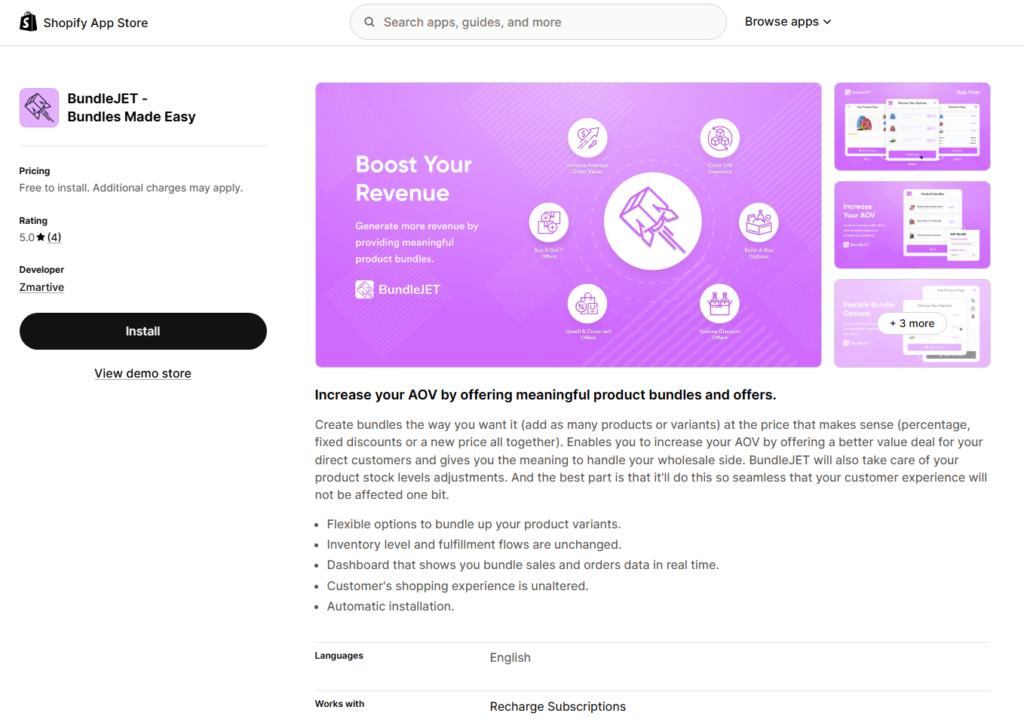
Best for: Merchants who want build-a-box bundles and wholesale-style pricing without a steep learning curve.
BundleJET supports Buy X Get Y, build-a-box, volume discounts, and upsell/cross-sell offers, and automatically adjusts stock levels as bundles sell. It’s designed to handle both direct-to-consumer and wholesale pricing structures, which makes it a reasonable fit for stores that sell to both retail customers and wholesale accounts from the same catalog.
Merchants who switched to BundleJET from other bundling tools often mention that the setup process felt more straightforward than expected after having a frustrating experience elsewhere, and that support is responsive when customization requests come up. The ability to create separate bundle rules for different product categories is one of its more flexible features, letting you run different bundle logic for, say, apparel versus accessories within the same store.
Ideal store size: Small to mid-sized stores that sell both retail and wholesale, or that want flexible build-a-box functionality without a steep price tag.
Pros:
- Free to install.
- Flexible discount configuration (percentage, fixed amount, or new fixed price).
- Category-specific bundle rules.
Cons:
- Some merchants report a learning curve when setting up highly customized bundles across many product categories.
- Documentation could be more thorough for beginners.
App Store link: apps.shopify.com/bundlejet
8. Easy Bundles: Bundle Builder
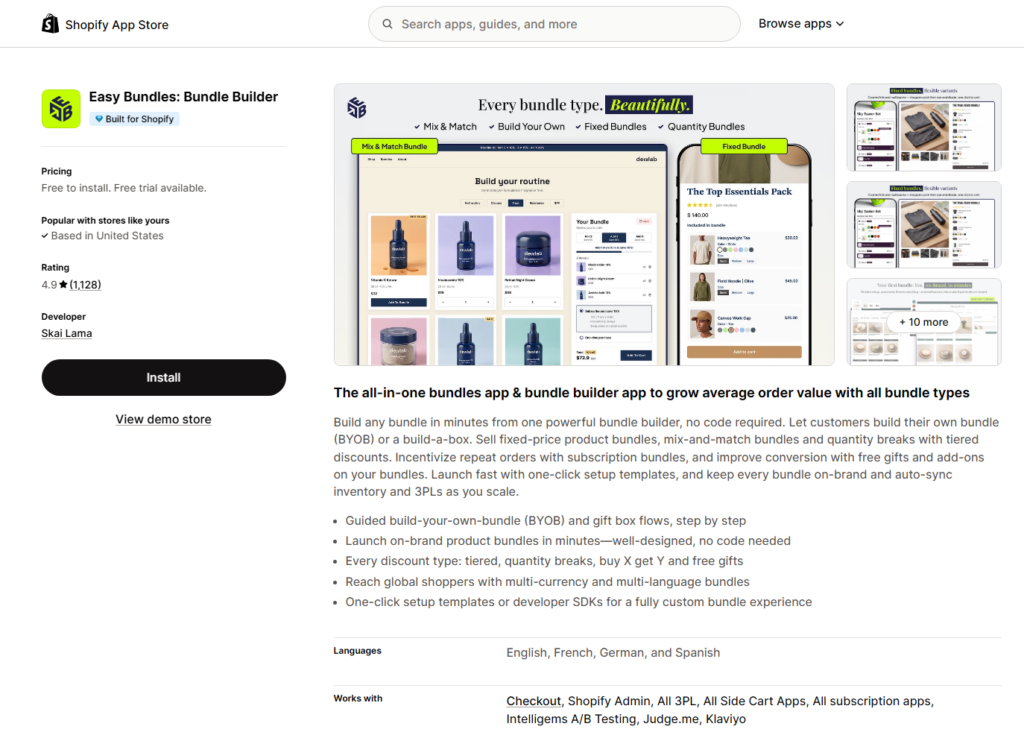
Best for: Stores that want customers to build their own bundle (BYOB) or build-a-box experience.
Easy Bundles lets shoppers assemble their own bundles or use build-a-box templates, and supports fixed-price bundles, mix-and-match, and tiered quantity break discounts. It also offers developer SDKs for stores that need a fully custom bundle experience beyond what the no-code templates provide.
This app is a strong fit if your product strategy leans toward letting the customer curate their own set, such as a build-your-own snack box, skincare routine, or gift set, rather than presenting them with pre-made combinations. The one-click setup templates make it easy to launch a basic BYOB experience quickly, while the SDK option is there for stores with development resources who want to build a fully custom bundling interface that matches a bespoke theme.
Ideal store size: Stores whose product strategy centers on customer-curated bundles or gift sets, including those with in-house development support for custom builds.
Pros:
- No-code templates for common use cases.
- Developer flexibility for custom builds.
- Strong BYOB and build-a-box experience.
Cons:
- Best suited to stores that specifically want a customer-facing “build your own bundle” flow rather than simple fixed bundles.
- Pricing is trial-based rather than offering a permanent free tier.
App Store link: apps.shopify.com/bundle-builder
What to Look for in a Shopify Bundle App
Before comparing apps, it helps to know what actually separates a good bundle app from a mediocre one:
- Bundle types supported – Fixed bundles are table stakes. Look for mix-and-match, volume discounts (quantity breaks), BOGO, and build-a-box if you need flexibility.
- Inventory sync – The app should pull from real component stock instead of forcing you to create separate SKUs for every bundle combination.
- Where the bundle appears – Product page widgets, cart drawer upsells, and post-purchase offers all convert differently. Cart-based bundles tend to convert better because the shopper already has buying intent.
- Checkout and discount compatibility – Confirm the app applies its discount in a way that doesn’t conflict with your existing Shopify discount codes.
- Theme performance – Apps built on Shopify’s theme app blocks and Shopify Functions tend to load faster and are less likely to hurt page speed than older apps that edit theme code directly.
- Pricing model – Some apps charge flat monthly fees, others take a commission on revenue generated through bundles. Read the pricing page carefully before committing.
- Ease of migration – If you’re switching from an app that shut down or raised prices, check whether the new app has a bulk import tool so you’re not rebuilding hundreds of bundles by hand.
- Reporting and analytics – You want to know which bundles are actually driving incremental revenue versus just cannibalizing full-price sales. Apps with built-in bundle-level analytics make this much easier to track over time.
How to Choose the Right Bundle App for Your Store
There’s no single best product bundle app for every Shopify store, and the right choice depends mostly on your catalog and your priorities:
- If you want to test bundling with zero cost, start with the native Shopify Bundles app and upgrade only if you outgrow its 3-option limit.
- If you run a high-SKU catalog with multiple fulfillment channels, Simple Bundles & Kits is built for that complexity.
- If predictable flat pricing matters more than advanced AI features, Bundler is the safer long-term bet.
- If you want AI-assisted merchandising and are comfortable with usage-based pricing, Fast Bundle offers the deepest feature set.
- If your focus is purely quantity breaks and BOGO offers, Kaching is a fast, narrowly focused option with a strong track record.
- If you want bundling combined with upsells and lookbooks in one platform, Amplify covers more ground, provided you’re comfortable with its pricing structure.
- If your product strategy relies on customer-curated bundles, Easy Bundles’ BYOB tools are the closest fit.
- If you sell to both retail and wholesale customers, BundleJET’s flexible pricing rules are worth testing.
Most bundle apps offer either a free plan or a free trial, so it’s worth installing your top two or three candidates on a development store and testing the actual setup experience before committing to a paid plan.
Frequently Asked Questions
What is the best free Shopify bundle app?
Shopify Bundles, the native app built by Shopify, is completely free but limited to simple fixed bundles. Among third-party apps, Simple Bundles & Kits, Bundler, BundleJET, and Kaching Bundles App & Upsells all offer usable free plans before you need to upgrade.
Do Shopify bundle apps work with existing discount codes?
It depends on the app. Shopify limits how native discount types combine, so most bundle apps generate their own discount mechanism rather than relying on standard discount codes. Check each app’s documentation to confirm how it handles stacking with your existing promotions.
Will a bundle app slow down my store?
Apps built on Shopify’s theme app blocks and Shopify Functions, such as Kaching and Shopify Bundles, load asynchronously and have minimal impact on page speed. Older apps that edit theme code directly can affect load times like Largest Contentful Paint (LCP), so check how an app injects its widget before installing.
What’s the difference between mix-and-match, BOGO, and quantity break bundles?
Mix-and-match lets shoppers pick any combination of items from a collection for a set discount. BOGO (buy one, get one) gives a free or discounted item after a qualifying purchase. Quantity breaks (volume discounts) lower the price per unit as the customer adds more of the same or related items to their cart.
How much do Shopify bundle apps cost?
Pricing varies widely. Native Shopify Bundles is free. Third-party apps typically range from free plans with limited bundles up to $20 to $60 per month for advanced features, and a few charge a percentage of revenue generated through the app rather than a flat fee. Always confirm the current pricing on the app’s Shopify App Store listing, since plans change.
Can I use more than one bundle app at the same time?
It’s technically possible, but not recommended. Running two bundle apps at once can cause conflicting discount logic at checkout, duplicate inventory adjustments, or bundles that display incorrectly on the storefront. Most merchants get better results picking one bundle app that covers the offer types they need and configuring it thoroughly rather than layering multiple apps.
What happens to my bundles if I switch apps later?
This depends on the app you’re leaving and the one you’re moving to. Some bundle apps, like Simple Bundles & Kits and BundleJET, offer bulk import tools that speed up migration, while others require bundles to be rebuilt manually. Before switching, export any bundle configuration data you can, and check the new app’s documentation or support team for migration assistance, especially if you have hundreds of active bundles.
Do bundle apps affect SEO?
Bundle apps generally don’t hurt SEO directly, since the bundle offer itself is a merchandising layer rather than new indexable content. However, apps that create a bundle as its own product page can add valuable long-tail landing pages if you write unique titles and descriptions for each bundle rather than duplicating your existing product copy.
Final Thoughts
If you’re just starting out and want to test whether bundling moves your AOV, Shopify’s native Bundles app or a free plan from Bundler or BundleJET is a low-risk way to begin. If your catalog has many variants and you need real inventory sync across fulfillment channels, Simple Bundles & Kits is worth the setup time. For stores that want AI-assisted merchandising alongside bundling, Fast Bundle and Amplify are the more feature-rich options, though it’s worth reading current App Store reviews for both before committing to their pricing model.
All app names, ratings, and links above were current on the Shopify App Store at the time of writing. Always verify pricing and reviews directly on the app’s listing before installing, since Shopify apps update their plans frequently.
Help us grow by sharing this Post!